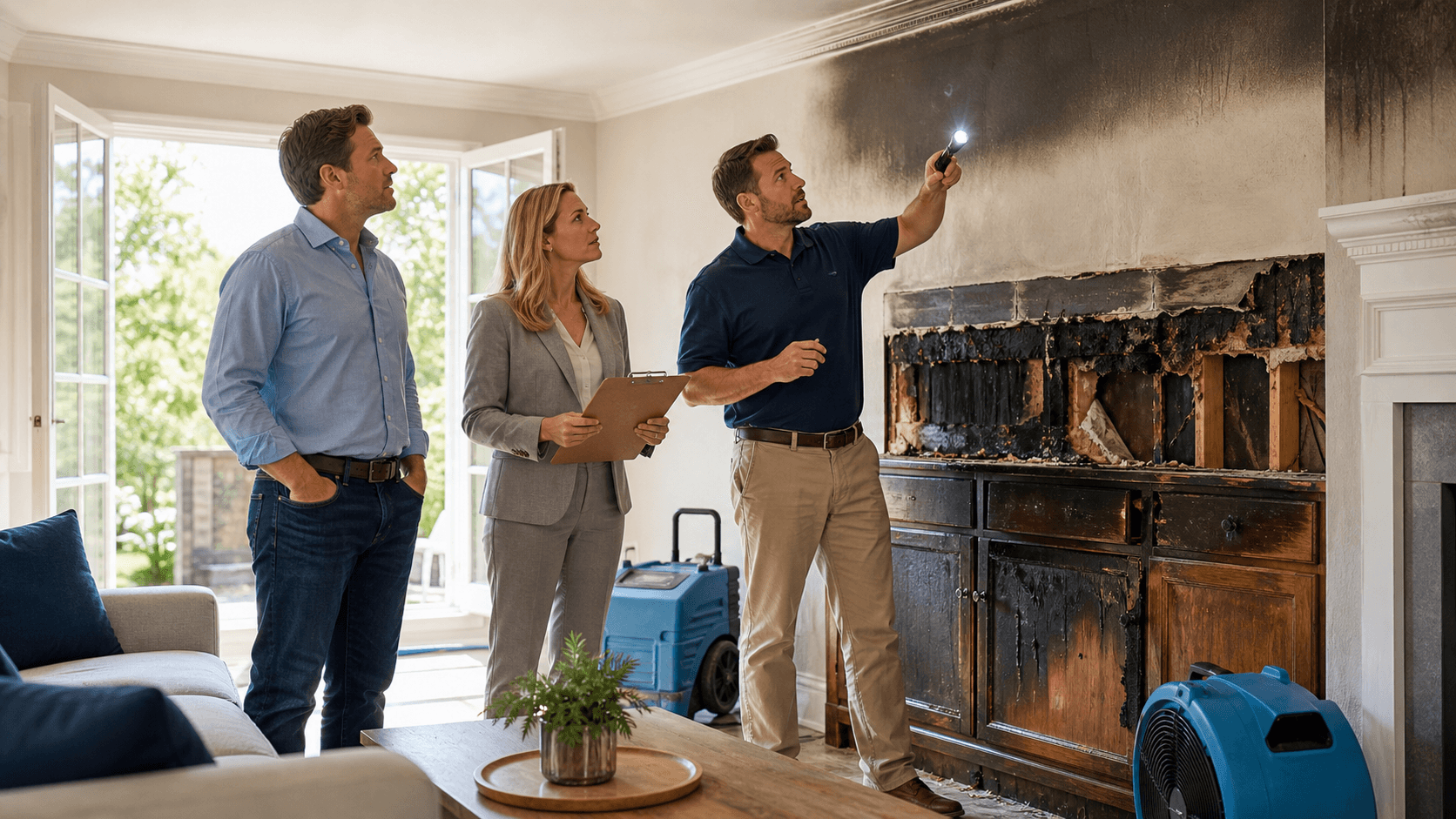
When Fire Spares the Structure But Smoke Ruins the Property
A building can come through a fire without a single wall being burned and still be badly damaged. That often happens when smoke, soot, and combustion byproducts move through the space, get into the HVAC system, and settle on surfaces and contents. The structure is standing, but the property is not truly usable, especially for Texas businesses that depend on clean air, sensitive equipment, and consistent operations.
Smoke-only losses in Texas tend to show up in a few recurring ways on commercial and higher-value residential risks:
- A nearby building catches fire and smoke drifts into your property.
- A tenant has a small kitchen fire that is put out fast, but the smoke fills multiple floors.
- An electrical panel smolders, throws off thick smoke, and is shut down before open flames spread.
From the outside, the building can look fine, yet the inside tells a different story.
Many owners are surprised when the insurer denies or minimizes these claims because there is no obvious charring or because the adjuster calls it "only odor." Operations slow or stop, customers or tenants complain, staff report headaches, and you are left with a short estimate for superficial wipe-downs and deodorizer. At that point, experienced Texas policyholder counsel can often reframe what is being treated as a minor housekeeping issue into the covered fire-related loss the policy is supposed to address.
How Texas Property Policies Treat Smoke-Only Fire Losses
Most Texas commercial and high-value residential property policies address fire, smoke, and direct physical loss as related but distinct concepts. Those words are not decoration; they influence whether a smoke claim is paid fully or pushed aside.
Common features in these policies include:
- Defining fire as a hostile fire once flames escape where they are supposed to be
- Listing smoke as a named or specified peril in the covered causes of loss
- Excluding smoke from certain operations (such as agricultural smoke or industrial venting)
- Adding endorsements that limit or expand smoke coverage
Smoke-only losses often trigger disputes over what qualifies as "direct physical loss." Carriers may argue that if a wall is not burned or broken, there is no covered damage. From a policyholder perspective, that ignores the reality that microscopic soot particles, acid gases, and residue can bond to surfaces, corrode metals, and damage electronics and HVAC components.
Sophisticated owners should be cautious when they hear lines such as:
- It is only cosmetic.
- It is just an odor issue.
- It is a simple housekeeping problem.
- It should fall below the deductible.
Under Texas law, smoke infiltration can constitute direct physical loss when it changes the condition of the property and requires actual remediation, not just air freshener or light cleaning. In appropriate cases, that can support claims for full cleaning, selective replacement of building materials and contents, and, where the policy allows it, business interruption or loss-of-use coverage while the work is performed.
Typical Insurer Arguments to Minimize Smoke Damage Claims
Insurers use a familiar set of arguments when they want to keep a smoke claim small or off the books. Understanding those patterns helps commercial owners and other policyholders recognize issues early in the adjustment process.
Common denial and underpayment themes include:
- Asserting there is no direct physical damage because nothing is charred
- Pointing to preexisting discoloration or wear and tear instead of the smoke event
- Blaming poor maintenance, dirty ducts, or bad ventilation instead of covered smoke
- Arguing that any real damage is under the deductible
Adjustment tactics can also keep the apparent value of the claim down. A carrier may send an adjuster for a quick walk-through, skip tight spaces and ceiling cavities, and approve only limited cleaning of obvious surfaces. HVAC systems, subceilings, insulation, and concealed chases are often ignored or quickly dismissed.
In Texas property claims, we frequently see carriers:
- Use low-cost restoration vendors who do not test for soot or residue penetration
- Reject or downplay corrosion on metal and electronics as unrelated
- Claim that tenant build-outs or business personal property fall outside the insured's coverage grant
- Treat separate losses, such as electronics failure weeks later, as unrelated events
These are the kinds of issues experienced policyholder firms litigate regularly in larger commercial, industrial, and mixed-use property disputes.
Proving Smoke Damage the Carrier Wants to Overlook
Smoke damage is not always obvious to the naked eye, especially in complex buildings. The quality of your proof matters. Solid evidence can convert what the insurer is treating as a nuisance claim into a fully documented property and business interruption loss.
For significant smoke events, policyholders often need professional assistance with:
- Industrial hygiene testing to assess air and surface contamination
- Wipe samples on walls, contents, and ductwork to identify soot and residue
- HVAC and duct inspections to track smoke migration through the mechanical system
- Detailed scopes of work and cost estimates from qualified restoration contractors
- Content inventories showing which items are restorable and which are not economically or technically feasible to restore
Contemporaneous documentation is just as important as expert testing. When a loss occurs, it is useful to collect:
- Photos and video during and immediately after the smoke event
- Incident reports from employees, tenants, or building staff
- Maintenance logs and service records for HVAC and electrical systems
- Records of complaints about odor, headaches, soot on desks or residue on inventory or equipment
Experienced Texas coverage counsel can coordinate these pieces so they tell a coherent story that fits within the policy language. The objective is to demonstrate that the building and contents are contaminated in ways that cannot be remedied by superficial cleaning and paint, and to connect any loss of income or loss of use directly to the covered smoke event.
Strategic Considerations Before You Accept or Challenge a Denial
Once a carrier issues a denial or a very low offer, your next steps can significantly affect your rights. Moving too quickly to close the claim or undertake major repairs can give the insurer arguments it otherwise would not have.
Before you accept a denial or inadequate payment, consider steps such as:
- Requesting in writing a clear explanation of the insurer's coverage position and the factual basis in the claim file
- Gathering all policy forms, endorsements, and any lender requirements related to the building
- Avoiding broad releases or "full and final" settlement language tied to insufficient payments
- Preserving damaged items, filters, and key components when possible, instead of discarding everything
Texas policies often include notice provisions, suit limitation clauses, and cooperation requirements. Owners who proceed with partial repairs, tenant build-outs, or new leases while the claim is in dispute should be careful not to waive rights or miss critical deadlines.
Engaging experienced policyholder counsel is especially important where:
- Ownership or lease structures are complex
- There are high-value build-outs, specialized equipment, or critical tenant operations
- Coverage is layered with primary and excess policies, or involves manuscript forms
- Lenders, investors, or large tenants have contract rights tied to insurance proceeds
- The insurer is shifting explanations, delaying inspections, or ignoring reasonable documentation
A policyholder-only firm can navigate these issues without the conflicts that come with representing insurers.
Repositioning a Denied Smoke Claim in Texas
Smoke-only losses are easy for carriers to label as minor or cosmetic, particularly when the structure still looks intact from the outside. For Texas commercial and high-value residential policyholders, that label can conceal significant impacts on operations, tenant relations, and long-term asset value.
Lundquist Law Firm represents policyholders only in first-party property insurance disputes. We focus on complex, high-value losses, including fire and smoke claims, business interruption, and related bad faith or unfair-claims-handling issues under Texas law. In a smoke-driven fire loss, we work from the policy outward: assessing coverage, measuring the full scope of property and time-element loss, and aligning the physical damage with any business interruption, extra expense, or soft cost coverage that may apply.
Handled correctly, that process can reposition a denied or underpaid smoke claim for serious negotiation or, when necessary, litigation in Texas courts or arbitration forums, so that a loss the insurer tried to minimize is treated as the substantial property and income loss it truly is.
Protect Your Rights After a Fire Loss
If your fire insurance claim has been delayed, underpaid, or denied, you do not have to navigate the next steps alone. Our denied fire insurance claim attorney can review your policy, evaluate your losses, and explain your legal options. At Lundquist Law Firm, we work to challenge unfair claim decisions and pursue the full recovery you may be entitled to. To discuss your situation directly with our team, please contact us today.