A Texas federal court's recent ruling in a hailstorm dispute,Trinity Fellowship Church of Pampa v. Church Mutual Insurance Co., S.I., No. 2:25-CV-019-Z (N.D. Tex. Sept. 16, 2026), shows exactly how an Xactimate estimate can become a liability instead of an asset in litigation. A Xactimate estimate can be an important part of a Texas property insurance claim, but the software output does not prove the extent or cost of covered damage by itself. The reliability of an estimate depends on the inspection work, photographs, quantities, pricing, repair scope, and professional judgment behind every line item.
For commercial property owners dealing with hail, wind, fire, or internal water losses, early review of the damages record can shape the entire claim. Disputes involving Xactimate estimates require more than a large total at the bottom of the page.
Xactimate Output Alone Does Not Prove Property Damage
Xactimate is widely used by insurers, contractors, consultants, and damages experts. It organizes labor, materials, equipment, and repair line items into a detailed estimate. But the program only reflects the information entered into it, and Texas courts have said so directly.
In McGinty v. Hennen, 372 S.W.3d 625 (Tex. 2012), the Texas Supreme Court held that an estimate generated through a widely used software program, Xactimate, does not by itself establish that the repair costs in that estimate are reasonable and necessary. The homeowner's contractor had used Xactimate to estimate more than $650,000 in remediation costs, but neither expert testified that the resulting figures were reasonable or necessary, and the court found that testimony about how the estimate was derived did not, standing alone, make the figure reasonable. The jury's damages finding was legally insufficient as a result.
McGinty set the baseline that Texas courts, state and federal, apply whenever a damages case turns on an Xactimate printout: the software is a pricing tool, not proof.
A Federal Court Applied That Standard in Trinity Fellowship Church v. Church Mutual
Trinity Fellowship Church of Pampa shows how that standard plays out when an Xactimate estimate changes dramatically between versions. A June 2023 storm allegedly caused hail damage to the roof and siding of Trinity's church building in Pampa, Texas. Church Mutual's independent adjuster inspected the property, found limited damage, and estimated repair costs at $9,085.39, below the church's $168,660 deductible. Trinity disagreed and submitted its own contractor's estimate, prepared using Xactimate, totaling $1,339,163.97.
Church Mutual then retained an engineer, who inspected the property and concluded that the exterior claddings and roofing were not damaged by wind or hail, and that the interior moisture problems were consistent with long-term weathering rather than the storm. Based on those findings, Church Mutual's building consultant estimated covered repairs at roughly $98,683.01, still below the deductible for the roof itself, and the insurer paid $11,323.85 for damage to other structures on the property.
More than a year later, after new counsel sent a pre-suit demand, Trinity's claimed damages had grown to $18,793,593.60 in actual and treble damages, built around a revised Xactimate estimate from its own contractor totaling $6,445,384.05, nearly five times the contractor's original number for what the court described as "a nearly identical scope of work."
Trinity sued for breach of contract, Texas Insurance Code violations, violations of the Texas Deceptive Trade Practices Act, and breach of the duty of good faith and fair dealing. Church Mutual moved to exclude the testimony of Trinity's two retained experts, who had built their opinions around the escalated Xactimate estimate. The court found that Trinity's experts had altered the software's default unit costs, waste factors, labor rates, and markups in roughly two dozen documented ways, pushing the numbers well above Xactimate's own defaults without a stated, code-based justification for most of the changes. The court excluded both experts' damage opinions in their entirety as unreliable, while leaving the door open for the same witnesses to testify about their own observations as fact witnesses rather than experts.
Meanwhile, the court denied Trinity's motion to exclude Church Mutual's own experts, finding their causation opinions adequately accounted for alternative explanations for the interior moisture and were not simply duplicative of one another.
Excluding the expert testimony did not end the damages question, however. Because the estimates already in the record ranged from $9,085.39 to $1,339,163.97, the court held that the size of the loss remained a genuine, triable fact question for the jury, not something it could resolve on summary judgment, even without an admissible expert opinion anchoring a higher figure.
The court ruled for the insurer on several other claims. It granted summary judgment to Church Mutual on the common-law and statutory bad faith claims, finding the insurer had a reasonable basis for its initial determination and could not be faulted for failing to act on an internal estimate from its own adjuster that was never shared with the claims team. It also granted summary judgment on Trinity's misrepresentation claims under Chapter 541 of the Texas Insurance Code, holding that most of the alleged misstatements concerned the extent and cause of the damage rather than the terms or benefits of the policy itself, which is what that statute addresses. The court further held that Church Mutual's communication explaining that the damage fell below the deductible was a reasonable explanation under the Insurance Code, even though Trinity disagreed with the conclusion. Trinity's breach of contract and prompt payment claims were not part of the motion and remain pending for trial.
The lesson is a sharper version of the one courts have been teaching since McGinty: an Xactimate estimate that departs from the software's own defaults, without a documented reason for each departure, invites exactly the kind of challenge that ended Trinity's expert testimony here. Losing the experts did not automatically cap the recoverable damages, since a jury can still weigh the competing estimates already in the record, but it did strip away the only evidence that would have supported the revised, multi-million dollar figure as reliable expert opinion rather than simply a number a witness is prepared to say in court.
Xactimate Can Be Useful but Not Self-Authenticating
In serious first-party property disputes, Xactimate estimates often come from both sides. The platform can provide a structured starting point for analyzing repair costs. Yet software does not replace a reliable damage investigation or expert analysis.
A defensible estimate should identify what property was damaged, explain why repair or replacement is needed, and show how the preparer reached the quantities and pricing used. It should account for project-specific conditions, such as access limitations, sequencing, code requirements where covered, and the realities of repairing an occupied commercial building. That record is what McGinty and Trinity Fellowship Church both point to: testimony about how an Xactimate figure was generated is not, by itself, evidence that the figure is reasonable.
Insurers may argue that a policyholder's estimate is inflated, duplicative, unsupported, or unrelated to the reported event. Policyholders should apply the same scrutiny to the carrier's estimate. A low insurer estimate may omit roof or exterior components after hail or wind damage, apply inadequate pricing, use unsupported depreciation, or leave out work required to complete a proper repair. The issue is not simply which estimate is higher; it is whether the estimate can be supported with evidence and a sound method.
Early Review Matters in Litigation Involving Xactimate Estimates
Before a claim goes to litigation, the estimate should be carefully reviewed alongside the full damages record. In our work representing Texas policyholders only, we examine how the estimate fits with the policy, the inspection evidence, the cause of loss, and the insurer's stated reasons for limiting or denying payment.
For substantial commercial losses, relevant materials may include:
- Photographs, inspection notes, drone images, and repair recommendations
- Contractor proposals, invoices, engineering opinions, and building plans
- Communications with the insurer and all versions of carrier and policyholder estimates
- Policy provisions addressing valuation, depreciation, replacement cost, and covered upgrades
- Records relating to operations, tenants, lost income, and extra expense
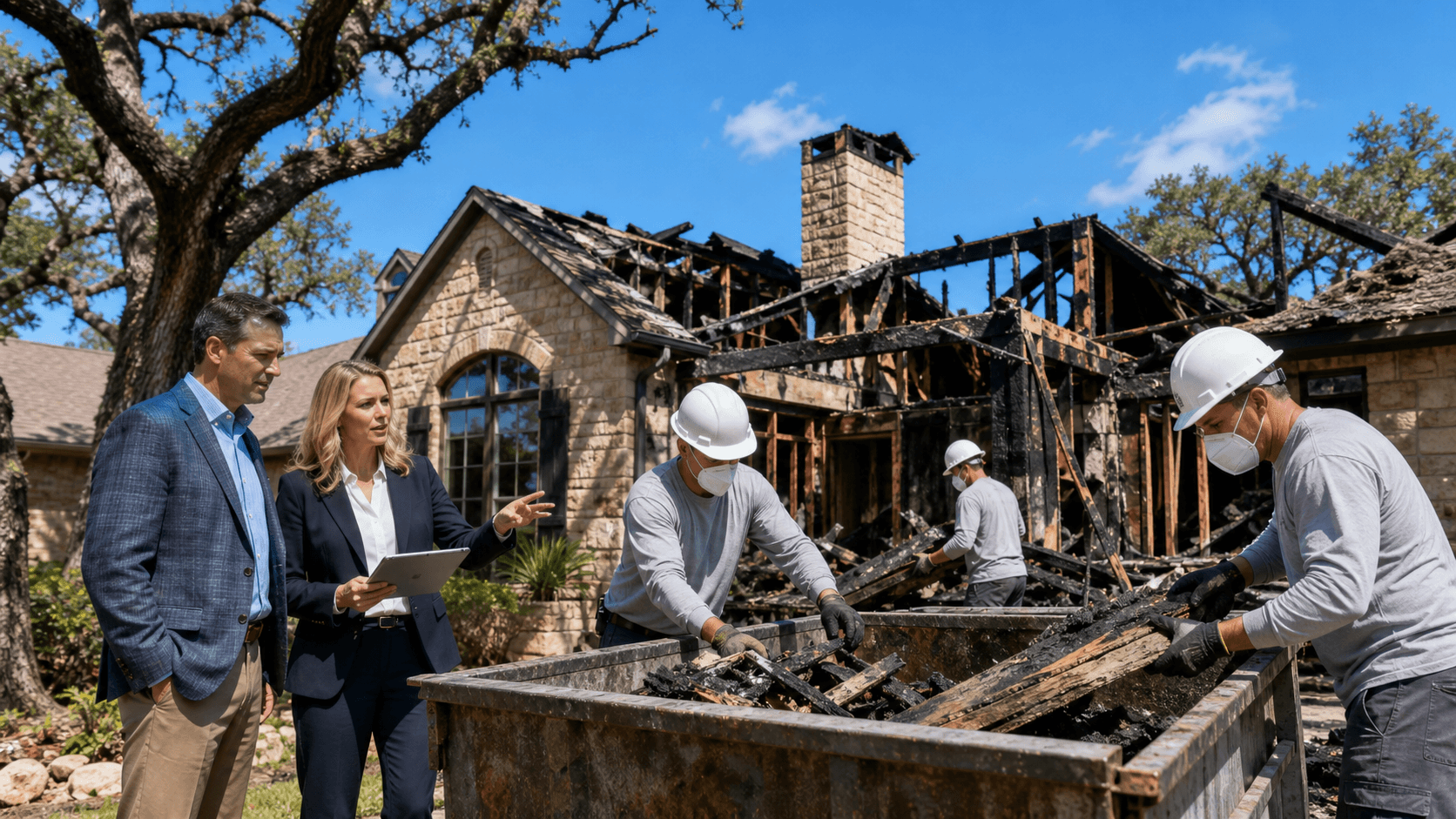
As Trinity Fellowship Church illustrates, an estimate that balloons between versions, without a documented, line-by-line reason for the change, can become evidence that a claim lacks support, well before any Daubert motion is filed. Scope disputes can arise in many settings. A hail claim may involve missing roof, flashing, gutter, or exterior items. A fire claim may require more than surface cleaning if smoke, soot, demolition, and rebuilding issues are present. A pipe burst, plumbing leak, or sprinkler failure may require careful analysis of demolition, drying, repairs, and business disruption, without confusing the loss with unrelated pre-existing conditions.
Commercial property losses also may involve more than direct repair costs. A well-supported damages presentation may need to address business interruption, extra expense, tenant impacts, covered code upgrades, and the practical sequence of repairs at a revenue-producing property.
Evaluate the Damages Record Before the Dispute Escalates
Insurers frequently challenge both the amount and cause of loss. They may point to alleged wear and tear, prior damage, maintenance concerns, vacancy, exclusions, notice issues, or policy conditions. An estimate without a reliable foundation, like the altered Xactimate reports at issue in Trinity Fellowship Church, can give the insurer an opening to attack valid parts of the claim. By contrast, a carefully developed damages analysis can expose improper scope reductions, lowball pricing, delayed investigation, and unsupported claim-handling positions.
The need for reliable evidence is not a reason to accept an insurer's estimate without question. Preserve inspection records, photographs, repair documents, contractor proposals, communications, and every version of the estimates. Testing the damages record early can identify unsupported alterations, missing scope, and proof issues before they become central problems in litigation.
Address Estimate Disputes With a Litigation Strategy
Lundquist Law Firm represents policyholders facing underpaid property claims where estimate revisions, scope reductions, or unsupported pricing affect the value of the loss. Our experience with litigation involving Xactimate estimates, including decisions likeMcGinty v. Hennen and Trinity Fellowship Church of Pampa v. Church Mutual Insurance Co., helps commercial property owners assess whether an insurer's valuation, or their own, can withstand scrutiny. To discuss a disputed first-party property claim, contact us for an evaluation of the available legal options.